
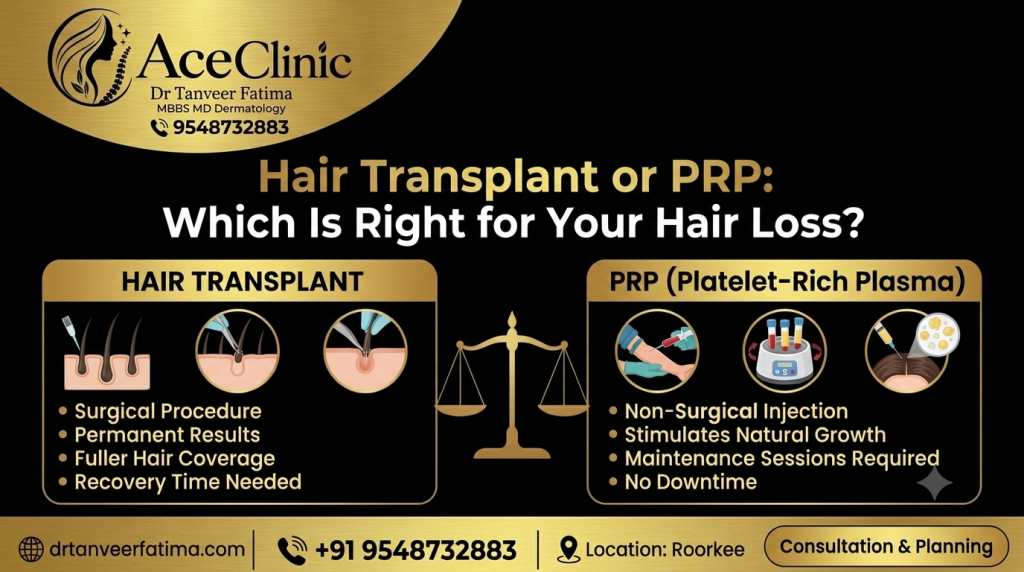
Hair loss can shake your confidence, and the first question most people ask is: should I get a hair transplant or PRP? If you are searching for hair transplant in Roorkee or PRP treatment in Roorkee, you have probably seen both options and felt confused.
Here is the short answer. PRP works best when you still have living hair roots and want to slow hair fall and make thin hair stronger. A hair transplant is for areas where the roots are gone and the scalp has become bald. The right choice depends on your hair loss stage, its cause and your goals. This guide explains everything in simple words, so you can decide with clarity.
Quick Answer: Hair Transplant or PRP?
- Choose PRP if your hair is thinning, your parting is widening, or hair fall has started recently.
- Choose a hair transplant if you have clear bald patches, a receding hairline or advanced baldness, and enough donor hair at the back of your head.
- Choose both if you want new hair in bald areas and stronger hair in the rest of your scalp.
But before choosing any treatment, you need to know why your hair is falling.
Why Is Your Hair Falling? Find the Cause First
What Is PRP Treatment for Hair Loss?
PRP stands for Platelet-Rich Plasma. It is a non-surgical treatment that uses your own blood. A small amount of blood is taken, spun in a machine to separate the platelet-rich portion, and then injected into the scalp using fine needles.
Platelets contain growth factors that can wake up weak hair follicles and support healthier growth. Because it uses your own blood, the risk of allergic reaction is low.
What to expect from PRP treatment in Roorkee:
- The session takes about 45 to 60 minutes
- Numbing cream is used to keep you comfortable
- Most people need 3 to 4 sessions, spaced about a month apart
- You can return to normal routine the same day
- Improvement is usually noticed after 3 to 6 months
- Maintenance sessions are often advised later
PRP is best for early to moderate thinning in both men and women. It cannot grow hair on a fully bald area, because there are no active roots left to stimulate.
What Is a Hair Transplant?
A hair transplant is a surgical procedure. Healthy hair roots are taken from a donor area, usually the back of the scalp, and placed into thinning or bald areas. The two main techniques are:
- FUE (Follicular Unit Extraction): individual roots are taken one by one, leaving tiny dots that heal quickly
- FUT (Follicular Unit Transplantation): a thin strip of scalp is removed and divided into grafts
The transplanted hair usually falls out in the first few weeks, which is normal. New hair then begins to grow, and full results often take 8 to 12 months. Transplanted hair is long lasting because donor roots are naturally resistant to hair loss.
A hair transplant in Roorkee needs careful planning. The surgeon must check your donor hair, hairline design and overall scalp health before recommending it.
Hair Transplant vs PRP: Key Differences
|
Factor |
PRP Treatment |
Hair Transplant |
|---|---|---|
|
Type |
Non-surgical injections |
Surgical procedure |
|
Best for |
Early thinning, weak hair |
Bald patches, advanced hair loss |
|
Sessions |
3 to 4, plus maintenance |
Usually one main session |
|
Downtime |
Almost none |
A few days to weeks |
|
Results start |
3 to 6 months |
3 to 4 months, full at 8 to 12 |
|
Permanence |
Needs maintenance |
Long lasting |
|
Cost |
Lower per session |
Higher overall |
|
Pain |
Mild |
Done under local anaesthesia |
Neither treatment is better for everyone. They solve different problems.
Which Hair Loss Stage Needs Which Treatment?
Stage 1: Early hair fall. Hair is falling more than usual but the scalp still looks full. Treat the cause, use medicines if advised, and consider PRP.
Stage 2: Visible thinning. The parting looks wider, or the temples and crown look thin. PRP along with medical treatment usually works well.
Stage 3: Receding hairline or small bald spots. PRP can help the surrounding hair, but areas with no hair may need a transplant.
Stage 4: Advanced baldness. A hair transplant is usually the better option, supported by PRP and medicines to protect the remaining hair.
For women: Women more often have diffuse thinning than bald patches. So PRP and treating causes like thyroid, iron deficiency and PCOS are usually tried first.
Who Should Not Get PRP or a Hair Transplant?
These treatments may not be suitable if you:
- Have a blood disorder or are on blood thinners
- Are pregnant or breastfeeding
- Have an active scalp infection
- Have very limited donor hair (for transplant)
- Expect overnight or unrealistic results
An honest consultation matters here. A good doctor will tell you when a treatment is not right for you.
Can You Combine PRP and Hair Transplant?
Yes, and many doctors recommend it. A transplant fills the bald area, while PRP supports healing, strengthens the transplanted hair and protects your existing hair from further thinning. Think of it as building a new garden while also feeding the old one.
Other Hair Loss Treatments to Consider
Depending on your case, your doctor may also suggest:
- Minoxidil or other medicines
- Treatment for dandruff or scalp problems
- GFC or mesotherapy
- Nutritional support for deficiencies
- Laser therapy
Sometimes a mix of simple treatments works better than any single procedure.
Cost of Hair Transplant and PRP in Roorkee
Cost depends on several factors:
- Number of PRP sessions needed
- Number of grafts in a transplant
- Technique used
- Your hair loss stage
- Follow-up care and medicines
PRP costs less per session, but repeated sessions add up over time. A transplant costs more upfront but is often a one-time solution for bald areas. For an exact quote, book a consultation, because the price can only be given after examining your scalp.
Results, Recovery and Side Effects
After PRP: Mild redness, tenderness or a slight headache can occur for a day or two. Avoid washing your hair for the first 24 hours and skip heavy exercise for a day.
After a hair transplant: Expect swelling, scabbing and shedding of transplanted hair in the first weeks. Sleep with your head slightly raised, avoid scratching, and follow the medicine and shampoo schedule.
Be patient with both. Hair grows slowly, and real results take months, not days.
Myths vs Facts
Myth: PRP is a permanent cure. Fact: PRP improves hair strength but usually needs maintenance sessions.
Myth: A transplant stops all hair fall. Fact: Transplanted hair lasts, but your natural hair can still thin without proper care.
Myth: Both treatments are very painful. Fact: Numbing makes both procedures comfortable for most people.
Myth: Vitamins alone fix all hair fall. Fact: Vitamins help only when a deficiency is the actual cause.
Why Choose Ace Skin and Hair Clinic for Hair Treatment?
Choosing the right clinic matters as much as choosing the right treatment. Here is what patients can expect at Ace Skin N Hair Clinic:
- Diagnosis first: We find the cause of your hair loss before suggesting any treatment.
- Honest advice: You are told clearly whether you need medicines, PRP, a transplant or a combination.
- Skin and hair expertise: As a dermatology clinic, we treat the scalp, skin and hair together, which many hair-only centres do not.
- Personalised plans: No two scalps are the same, so every plan is made for your hair type and goals.
- Safe, hygienic procedures: Sterile kits and proper protocols are followed in every session.
- Clear follow-up: We track your progress and adjust the treatment when needed.
- Local convenience: Care is available close to home in Roorkee, with no need to travel to big cities for consultation.
Why See a Dermatologist in Roorkee Before Any Procedure?
Hair loss is a medical condition, not just a cosmetic one. A dermatologist in Roorkee can tell whether your hair fall is temporary or permanent, whether your scalp is ready for a procedure, and whether cheaper and simpler options can help first. This can save you time, money and disappointment. Consulting a qualified hair specialist in Roorkee also reduces the risk of wrong treatment or poor results.
FAQs
Is PRP better than a hair transplant?
Not always. PRP is better for early thinning, while a hair transplant is better for bald areas. The right option depends on your hair loss stage.
Can PRP replace a hair transplant?
No. PRP cannot grow hair where roots are already gone. It can strengthen existing hair and support a transplant.
How many PRP sessions are needed?
Most people need 3 to 4 sessions, about a month apart, followed by maintenance sessions.
How long does PRP last?
Results usually last 12 to 18 months with maintenance. This varies from person to person.
Is a hair transplant permanent?
Transplanted hair is long lasting because it comes from donor roots that resist hair loss.
Which treatment is best for women's hair loss?
Women often respond well to PRP and treatment of causes like thyroid problems, iron deficiency and PCOS. A transplant is considered only in selected cases.
Which treatment is best for women's hair loss?Is there a non-surgical hair treatment in Roorkee?
Yes. PRP, medicines, GFC and mesotherapy are non-surgical options, depending on your case.
Conclusion
The choice between a hair transplant and PRP is not about which is more popular. It is about what your scalp actually needs. If your hair is thinning and roots are still active, PRP and medical care can help. If you have bald areas, a transplant may be the answer, sometimes along with PRP.
The best first step is a proper scalp check. If you are looking for PRP treatment in Roorkee or hair transplant in Roorkee, visit Ace Skin N Hair Clinic and get honest, personalised advice from an experienced dermatologist.
Book your hair consultation today and take the first step towards healthier hair.
ACE Clinic
Address: ACE Skin and Hair Clinic, Dehradun Rd, near Vinay Vishal hospital, Nehru Nagar, Roorkee, Uttarakhand 247667
Phone No: +91-9548732883
Email: [email protected]
Timings: 09:00 AM TO 10:00 PM
Google Map Location Listing: https://maps.app.goo.gl/xC7d3epyAZRNRtRw5